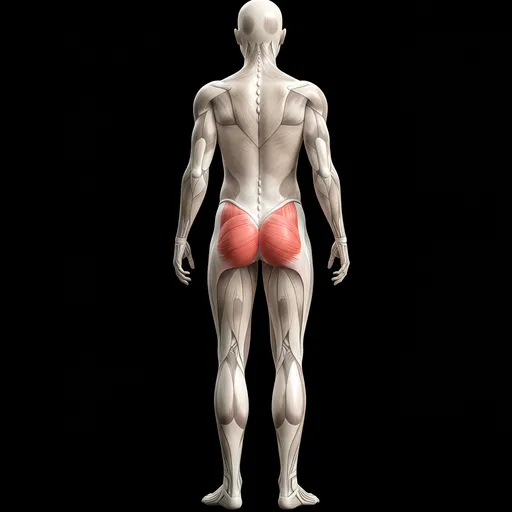
Which muscles does it train?
GlutesCalvesHamstrings
Equipment needed
How to perform it
For strength, 3 to 5 sets of 2 to 5 reps with 3 to 5 minutes of rest are common. For hypertrophy, use 3 to 4 sets of 6 to 10 reps with 2 to 3 minutes of rest.
Execution and technique cues
- Lie on your back with feet flat on the floor hip-width apart, roughly one hand's length from the glutes. Arms resting at your sides.
- Actively drive both heels into the floor, squeeze the glutes, and thrust the hips upward until the thighs and torso form a straight line.
- Hold the top position briefly and maximally contract the glutes. Avoid hyperextending the lower back: keep the ribs down and the core engaged.
- Lower the hips slowly and under control until they almost touch the floor, then immediately initiate the next rep.
Common mistakes
- Hyperextending the lower back at the top, causing the erector spinae to do the work instead of the glutes.
- Placing the feet too far from the glutes, which shifts emphasis to the knee extensors rather than the gluteal muscles.
- Rushing through reps without a pause at the top, preventing maximal glute activation.
Frequently asked questions
- What is the difference between a Glute Bridge and a Hip Thrust?
- In the Glute Bridge the entire back stays on the floor. In the Hip Thrust the upper back is elevated on a bench, which increases the range of motion and allows greater glute activation at the top.
- Can I add weight to the Glute Bridge?
- Yes. Place a barbell or dumbbell across the hip bones and hold it in place with both hands. Start light to maintain clean form before adding load.
Related exercises
Start free and track it
Log this exercise in Ironstead. Free forever for athletes, no auto-renew.
Start free and track itConnect with a coach
Train with a coach? Link up in Ironstead so they write your plans and follow your progress.
Connect with a coachWrite plans as a coach
Build plans with this exercise and assign them to your athletes. 30-day trial.
Write plans as a coach