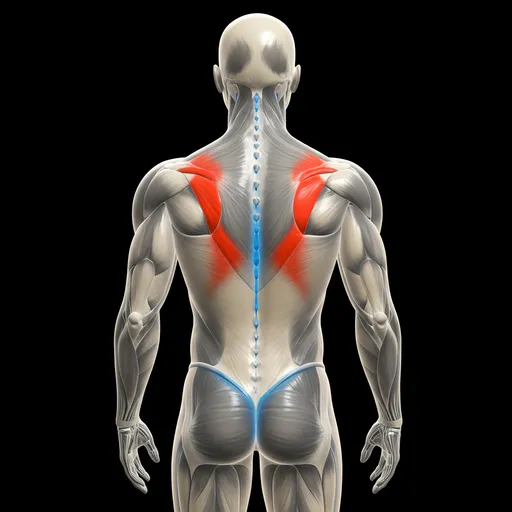
Which muscles does it train?
BackBicepsLats
Equipment needed
How to perform it
For strength, 3 to 5 sets of 4 to 6 reps with 2 to 3 minutes of rest are common. For hypertrophy, use 3 to 4 sets of 8 to 12 reps with 60 to 90 seconds of rest.
Execution and technique cues
- Straddle the barbell, place the feet shoulder-width apart, and bend the knees slightly to establish a stable stance.
- Hinge forward at the hips until the torso is at roughly a 45-degree angle, keeping the spine completely neutral.
- Pull the handle or bar toward the lower chest, driving the elbows up and back while squeezing the shoulder blades together.
- Lower the weight slowly to the starting position, letting the shoulder blades spread apart without rounding the back.
Common mistakes
- Standing up too straight during the lift, which shifts the emphasis from the back to the upper traps.
- Yanking the weight up using hip extension and momentum instead of controlled back contraction.
- Letting the lower back round at the bottom of the movement, increasing the risk of spinal strain.
Frequently asked questions
- Should I use small or large weight plates for the T-Bar Row?
- Using smaller plates (like 25lb/10kg plates) allows for a greater range of motion because larger plates hit the chest sooner.
- What is the difference between using a wide or close grip on the T-Bar Row?
- A close grip targets the lats and inner back more, while a wider grip emphasizes the upper back, rear delts, and traps.
Related exercises
Start free and track it
Log this exercise in Ironstead. Free forever for athletes, no auto-renew.
Start free and track itConnect with a coach
Train with a coach? Link up in Ironstead so they write your plans and follow your progress.
Connect with a coachWrite plans as a coach
Build plans with this exercise and assign them to your athletes. 30-day trial.
Write plans as a coach