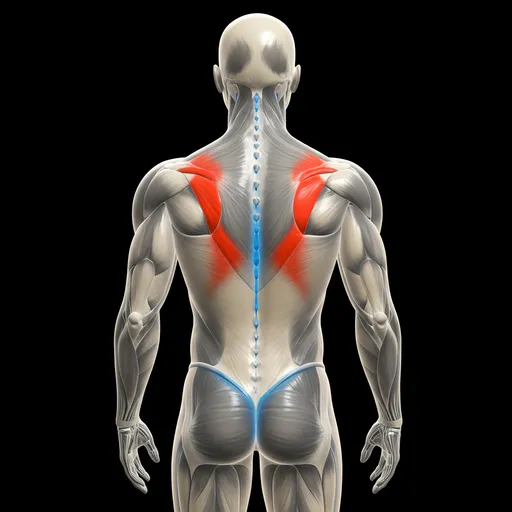
Which muscles does it train?
BackForearmsGlutesHamstringsTraps
Equipment needed
How to perform it
For strength, 3 to 5 sets of 2 to 5 reps with 3 to 5 minutes of rest are common. For hypertrophy, use 3 to 4 sets of 6 to 10 reps with 2 to 3 minutes of rest.
Execution and technique cues
- Set the barbell on blocks or in a rack so the bar sits at knee height or just above. Take a double overhand or mixed grip at shoulder width and position your hips directly over the bar.
- Brace the back by lifting the chest and establishing a neutral lumbar spine. Your hip angle will be slightly less acute than in a conventional deadlift due to the raised start position.
- Drive the floor away and extend the hips and knees simultaneously, keeping the bar in contact with or close to the thighs as it rises past the knees.
- Fully lock out the hips and knees at the top, then lower the bar back to the blocks under control. Set it down completely and rebuild your brace before each rep.
Common mistakes
- Rounding the upper back under load: A collapsed thoracic spine shifts shear forces onto the spine and reduces force transfer into the bar. Keep the chest up and the lats engaged throughout.
- Letting the bar drift forward: A bar that swings away from the body creates a longer moment arm and dramatically increases spinal loading. Drag the bar up the thighs on every rep.
- Touch-and-go reps instead of a full reset: The defining advantage of a block pull is training the top portion with a dead stop. Bouncing the bar off the blocks removes that stimulus and defeats the purpose of the variation.
Frequently asked questions
- Why use a Block Pull instead of a conventional deadlift?
- The Block Pull shortens the range of motion to emphasize the portion of the pull above the knees, particularly the lockout. It allows heavier loading than a full deadlift and is useful for building upper back and trap strength or addressing a weakness in the top half of the lift.
- What height should the blocks be set at?
- The most common starting point is knee height, with the bar sitting at patella level. A higher setting, such as mid-thigh, emphasizes lockout mechanics further. A lower setting approaches the conventional deadlift start position and demands more from the hip extensors.
Related exercises
Start free and track it
Log this exercise in Ironstead. Free forever for athletes, no auto-renew.
Start free and track itConnect with a coach
Train with a coach? Link up in Ironstead so they write your plans and follow your progress.
Connect with a coachWrite plans as a coach
Build plans with this exercise and assign them to your athletes. 30-day trial.
Write plans as a coach