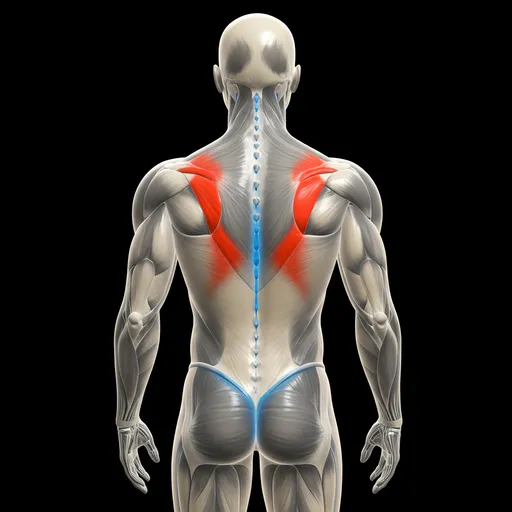
Which muscles does it train?
BackForearmsGlutesHamstringsQuadricepsTraps
Equipment needed
How to perform it
For strength, 3 to 5 sets of 2 to 5 reps with 3 to 5 minutes of rest are common. For hypertrophy, use 3 to 4 sets of 6 to 10 reps with 2 to 3 minutes of rest.
Execution and technique cues
- Stand on a stable raised surface 2.5 to 5 cm high (weight plates or a platform), set the feet hip-width apart, position the bar over the mid-foot, and grip it shoulder-width with the hands just outside the shins.
- Push the hips down into the starting position, lift the chest, establish a neutral spine, then engage the lats by trying to pull the bar into the floor before it breaks the ground.
- Drive the floor away by extending the hips and knees simultaneously, keeping the bar in contact with or close to the legs until it passes the knee, then drive the hips through forcefully to complete the lockout.
- Stand fully tall at the top with hips and knees locked out without hyperextending the lumbar spine, then hinge at the hips and lower the bar under control back to the floor.
Common mistakes
- Adopting a rounded lumbar spine in the start position because the deficit exceeds available hip mobility, which substantially increases spinal injury risk.
- Letting the bar drift away from the body as it breaks the floor, increasing the moment arm and disproportionately loading the lower back.
- Using weights that are too heavy for the deficit variation, leading to technical breakdown through the extended range of motion that would not occur in a standard deadlift.
Frequently asked questions
- How large a deficit should I use for the deficit deadlift?
- A deficit of 2.5 to 5 cm (one to two standard weight plates or a matching platform) is appropriate for most people. Larger deficits are only advisable when hip mobility is sufficient to maintain a neutral spine in the starting position.
- Who benefits most from the deficit deadlift?
- The deficit deadlift is particularly useful for strength athletes looking to improve off-the-floor pulling power, powerlifters addressing a weakness in the initial phase of the conventional deadlift, and anyone wanting to increase quad, glute, and hip extensor demand through a greater range of motion.
Related exercises
Start free and track it
Log this exercise in Ironstead. Free forever for athletes, no auto-renew.
Start free and track itConnect with a coach
Train with a coach? Link up in Ironstead so they write your plans and follow your progress.
Connect with a coachWrite plans as a coach
Build plans with this exercise and assign them to your athletes. 30-day trial.
Write plans as a coach