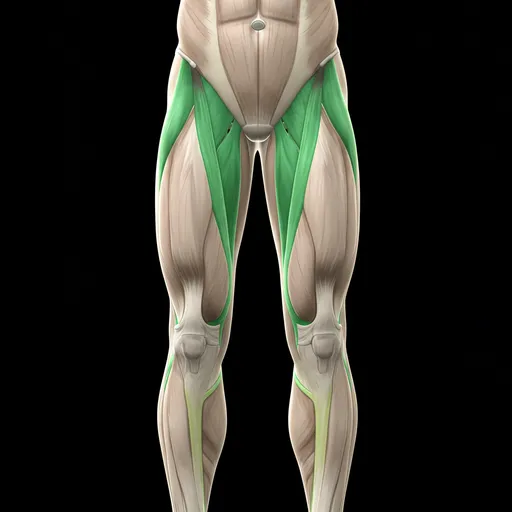
Which muscles does it train?
QuadricepsBackCalvesGlutesHamstrings
Equipment needed
How to perform it
For strength, 3 to 5 sets of 3 to 5 reps with 3 to 5 minutes of rest are common. For hypertrophy, use 3 to 4 sets of 6 to 12 reps with 2 to 3 minutes of rest.
Execution and technique cues
- Set the box behind you so that your hip crease reaches approximately knee height or just below when seated. Position the barbell on your upper back, step out to a shoulder-width or slightly wider stance, and turn your toes out slightly.
- Take a deep breath into the belly, brace the core hard, and push the knees out actively as you hinge the hips back and down. Keep the torso as upright as possible throughout the descent.
- Sit back fully onto the box and pause for a moment with the hips completely relaxed on the surface. Keep the knees over the toes, the back straight, and the core under tension. Do not collapse backward.
- Drive up explosively from the pause, extending the hips and knees simultaneously, and stand to full lockout. Exhale after you have risen clear of the box.
Common mistakes
- Falling onto the box: Losing hip tension at the bottom and dropping onto the box uncontrolled removes the eccentric stimulus and can be dangerous with heavier loads. The descent must stay muscularly controlled the entire way down.
- Forward lean on the way up: If the torso pitches sharply forward when leaving the box, load shifts to the lower back. Drive through the heels and keep the chest up out of the pause.
- Knees caving inward: Valgus collapse on the ascent indicates weakness in the glute medius and hip abductors. Actively drive the knees out in line with the toes from the moment you begin the ascent.
Frequently asked questions
- What is the advantage of the Box Squat over a regular squat?
- The Box Squat eliminates the stretch-shortening cycle by enforcing a full stop at the bottom. This requires the muscles to produce force from a dead start without relying on elastic energy stored during the eccentric phase. It also standardizes squat depth consistently across sets.
- What height should the box be set at?
- The standard box height places the hip crease at or just below knee level, corresponding to a parallel squat depth. A lower box increases range of motion and overall demand. A higher box is appropriate for beginners or during rehabilitation.
Related exercises
Start free and track it
Log this exercise in Ironstead. Free forever for athletes, no auto-renew.
Start free and track itConnect with a coach
Train with a coach? Link up in Ironstead so they write your plans and follow your progress.
Connect with a coachWrite plans as a coach
Build plans with this exercise and assign them to your athletes. 30-day trial.
Write plans as a coach