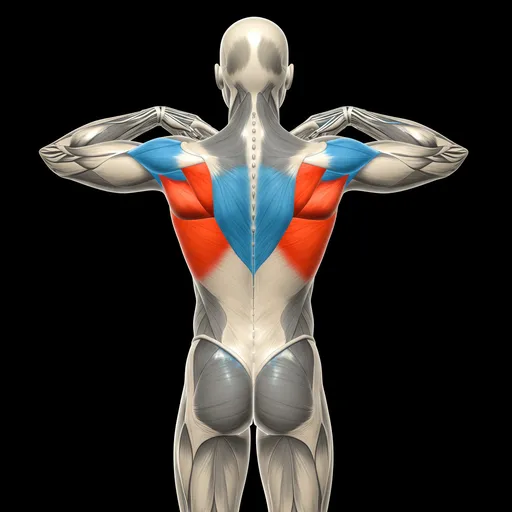
Which muscles does it train?
LatsChestShouldersTriceps
Equipment needed
How to perform it
For strength, 3 to 5 sets of 4 to 6 reps with 2 to 3 minutes of rest are common. For hypertrophy, use 3 to 4 sets of 6 to 12 reps with 90 to 120 seconds of rest.
Execution and technique cues
- Set a flat or slightly declined bench about one step from the cable stack, lie back with your head toward the machine, and grip the rope or bar attachment with both hands, arms extended overhead toward the pulley.
- Engage the lats before initiating the movement and maintain a slight, fixed bend in the elbows throughout to transfer the load from the shoulder joints to the back musculature.
- Pull the attachment in a wide arc down toward your hips, driven by the lats, until the arms are parallel to the floor or slightly below and you feel a strong contraction through the lats.
- Return the attachment slowly back overhead to the start position, using the lengthening phase to get a full stretch in the lats before starting the next rep.
Common mistakes
- Changing the elbow angle during the movement by bending and then pressing out, which turns part of the exercise into a triceps extension and reduces the lat stimulus.
- Shrugging the shoulders or using momentum to swing the weight, which shifts the work to the upper trapezius and shortens the effective range of motion for the lats.
- Letting the hips rise off the bench, which is a sign of excessive load or poor core stability. Keep the entire back in contact with the bench throughout every rep.
Frequently asked questions
- Is the cable pullover a back exercise or a chest exercise?
- The latissimus dorsi is the primary mover. The pectoralis major, particularly the lower fibers, and the long head of the triceps are secondarily active. It is used primarily as a lat isolation exercise in practice.
- What is the advantage of a cable pullover over a dumbbell pullover?
- The cable maintains resistance throughout the full arc, including at the top where a dumbbell provides little to no load. This gives a more consistent stimulus across the entire range of motion, particularly in the stretched position overhead.
Related exercises
Start free and track it
Log this exercise in Ironstead. Free forever for athletes, no auto-renew.
Start free and track itConnect with a coach
Train with a coach? Link up in Ironstead so they write your plans and follow your progress.
Connect with a coachWrite plans as a coach
Build plans with this exercise and assign them to your athletes. 30-day trial.
Write plans as a coach