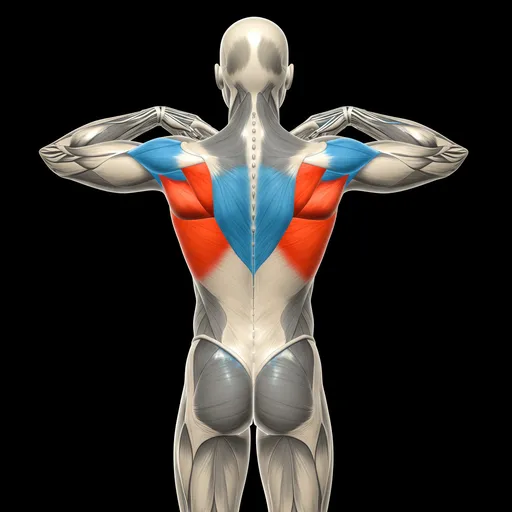
Which muscles does it train?
LatsBicepsForearmsTraps
Equipment needed
How to perform it
For strength, 3 to 5 sets of 4 to 6 reps with 2 to 3 minutes of rest are common. For hypertrophy, use 3 to 4 sets of 6 to 12 reps with 90 to 120 seconds of rest.
Execution and technique cues
- Hang from parallel pull-up bars with your palms facing each other and arms fully extended.
- Depress and retract your shoulder blades to engage the lats before initiating the upward pull.
- Pull your chest up toward the handles by driving your elbows down and back toward your ribs.
- Pass the bar with your chin under control, squeeze the shoulder blades, and lower yourself slowly to a dead hang.
Common mistakes
- Using momentum or kipping the legs to pull the body up, reducing lat muscle activation.
- Failing to lower the body all the way down, resulting in partial repetitions and incomplete range of motion.
- Allowing the shoulders to shrug upward toward the ears at the top of the movement.
Frequently asked questions
- Is a neutral-grip pull-up easier than a regular pull-up?
- Generally yes, because the neutral grip recruits the biceps and brachioradialis more effectively, providing mechanical assistance to the back muscles.
- What should I do if I cannot perform a single rep?
- You can use a resistance band for assistance, perform negative-only repetitions under control, or utilize an assisted pull-up machine to build the necessary strength.
Related exercises
Start free and track it
Log this exercise in Ironstead. Free forever for athletes, no auto-renew.
Start free and track itConnect with a coach
Train with a coach? Link up in Ironstead so they write your plans and follow your progress.
Connect with a coachWrite plans as a coach
Build plans with this exercise and assign them to your athletes. 30-day trial.
Write plans as a coach