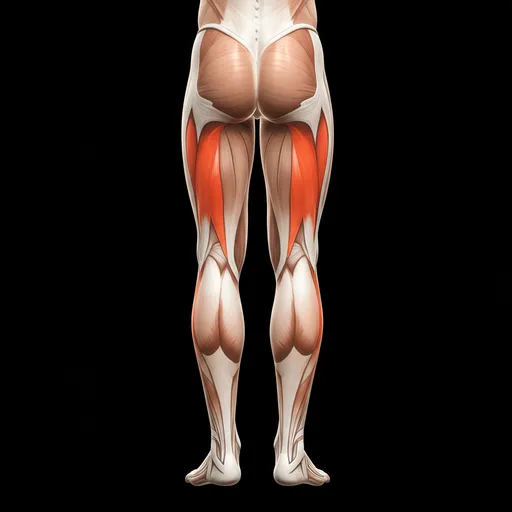
Which muscles does it train?
Calves
Equipment needed
How to perform it
Isolation work is usually trained in a higher rep range: 2 to 4 sets of 10 to 15 reps with 45 to 90 seconds of rest, performed under control.
Execution and technique cues
- Position the shoulder pads of the standing calf raise machine on your shoulders and place the balls of your feet on the platform with your heels hanging freely. Stand tall with a neutral spine and eyes forward.
- Push up into full plantarflexion as high as possible, squeezing the calves hard at the top while keeping a slight, constant bend in the knees throughout.
- Hold the peak position for one to two seconds to maximise the contraction, then begin a slow, controlled lowering phase.
- Lower the heels as far as the machine allows to achieve a full stretch at the bottom of each rep, letting the calves lengthen completely before initiating the next rep.
Common mistakes
- Bouncing at the bottom of the movement by using the stretch reflex to generate momentum, which reduces the time under tension in the muscle and increases stress on the Achilles tendon.
- Performing partial reps that skip the full plantarflexion at the top or the deep stretch at the bottom, significantly reducing the stimulus on the gastrocnemius and soleus.
- Overloading the weight to a point where full range of motion is impossible. Calves respond better to controlled reps through a complete range than to heavy loads with a shortened path.
Frequently asked questions
- What is the difference between the gastrocnemius and the soleus in the calf raise?
- The gastrocnemius is a two-joint muscle that is best trained with the knee extended, as in a standing calf raise. The soleus is a single-joint muscle that is preferentially loaded when the knee is bent, as in a seated calf raise. A complete calf training program benefits from including both variations.
- What rep range works best for the machine calf raise?
- The calf muscles contain a high proportion of slow-twitch fibres and typically respond well to moderate to high rep ranges of 12 to 25 reps. Full range of motion and a controlled tempo are more important variables than hitting a specific rep number.
Related exercises
Start free and track it
Log this exercise in Ironstead. Free forever for athletes, no auto-renew.
Start free and track itConnect with a coach
Train with a coach? Link up in Ironstead so they write your plans and follow your progress.
Connect with a coachWrite plans as a coach
Build plans with this exercise and assign them to your athletes. 30-day trial.
Write plans as a coach