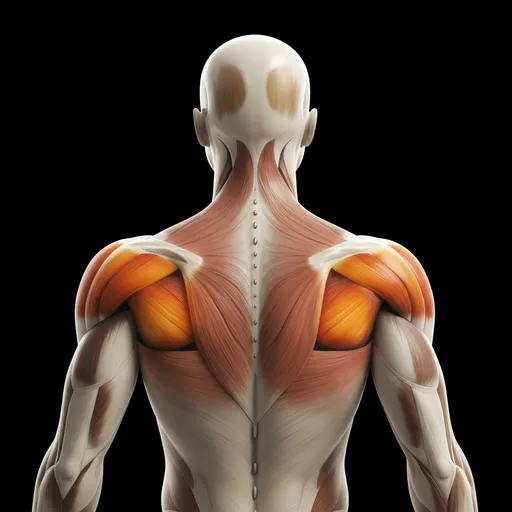
Which muscles does it train?
ShouldersAbsForearmsTriceps
Equipment needed
How to perform it
For strength, 3 to 5 sets of 3 to 6 reps with 2 to 3 minutes of rest are common. For hypertrophy, use 3 to 4 sets of 8 to 12 reps with 60 to 120 seconds of rest.
Execution and technique cues
- Hold the kettlebell bottoms-up at shoulder height with the handle pointing down and the bell facing up. Squeeze the handle as hard as possible to generate the tension needed to keep the bell stable before you press.
- Engage your core and pack the shoulder by actively pressing it into the socket while pulling the ribcage down. Keep the wrist straight and neutral throughout the movement.
- Press the kettlebell slowly and under control directly overhead, resisting any tipping or wobbling in the bell. The demand on the rotator cuff and forearm musculature is high, so prioritize control over speed.
- Lower the kettlebell back to shoulder height with the same level of tension and control as the press. Maintain grip and shoulder tension throughout the entire set before setting the bell down safely.
Common mistakes
- Releasing grip tension: As soon as the grip softens, the bell tips and the stabilizing musculature can no longer function properly. Maximum squeeze must be maintained for every rep of every set.
- Allowing the wrist to bend back: A hyperextended wrist shifts the bell out of the stable overhead line and increases joint stress. The wrist must stay straight from start to finish.
- Using too much weight: This variation is primarily a stability and motor control exercise, not a max-strength movement. The load should be considerably lighter than what you use for a standard kettlebell press.
Frequently asked questions
- What is the advantage of the Bottoms-Up Press over a standard Kettlebell Press?
- The inverted position creates an unstable system that places substantially higher demands on the rotator cuff, deep shoulder stabilizers, and forearm musculature. It is widely used to improve glenohumeral joint stability and as a shoulder prehab tool.
- Can I perform the Bottoms-Up Kettlebell Press with both arms at the same time?
- A bilateral variation with two bottoms-up kettlebells is possible but considerably harder to coordinate. The single-arm version is the standard starting point and allows you to focus on technique and stability for each side independently.
Related exercises
Start free and track it
Log this exercise in Ironstead. Free forever for athletes, no auto-renew.
Start free and track itConnect with a coach
Train with a coach? Link up in Ironstead so they write your plans and follow your progress.
Connect with a coachWrite plans as a coach
Build plans with this exercise and assign them to your athletes. 30-day trial.
Write plans as a coach