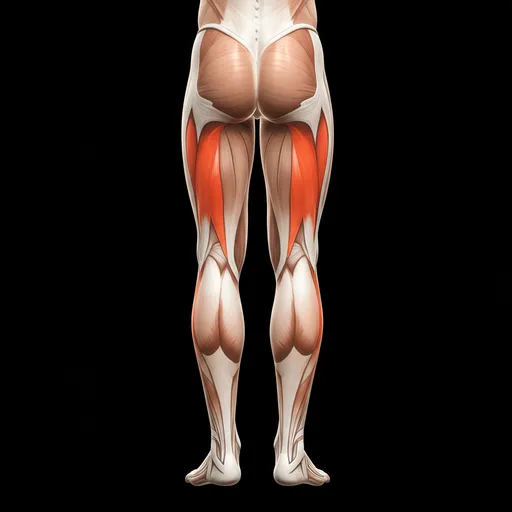
Which muscles does it train?
Calves
Equipment needed
How to perform it
Isolation work is usually trained in a higher rep range: 2 to 4 sets of 10 to 15 reps with 45 to 90 seconds of rest, performed under control.
Execution and technique cues
- Sit in the leg press and place only the balls of your feet and toes on the lower edge of the footplate, with your heels hanging freely off the platform. Keep the legs nearly fully extended but not locked out.
- Press the footplate away by driving into a full plantarflexion, pushing evenly through the balls of both feet and squeezing the calves hard at the top.
- Hold the peak contraction briefly at the top, then begin the controlled descent.
- Lower the footplate until the heels drop well below the level of the toes and you feel a deep stretch in the calves at the bottom. Complete the full range of motion on every rep.
Common mistakes
- Performing partial reps by failing to reach full plantarflexion at the top or a full stretch at the bottom, which significantly reduces the training stimulus for the calves.
- Allowing the knee angle to change during the movement by bending or straightening the legs, which alters how the load is distributed and can stress the knee unevenly. The legs should stay nearly extended throughout.
- Overloading the weight and cutting the bottom stretch short in order to control the load, sacrificing range of motion for heavier numbers on the stack.
Frequently asked questions
- How does the calf press on leg press compare to the standing calf raise?
- The leg press version removes the balance challenge and completely unloads the spine, making it a practical option for high-load calf training or for those with lower-back issues. The standing calf raise requires more stabilisation and allows a freer range of motion. Both are effective and complement each other well in a program.
- Does foot position on the footplate change which muscles are targeted?
- A neutral foot position is the standard starting point and loads the gastrocnemius and soleus evenly. Toes pointed slightly outward places a greater emphasis on the medial head of the gastrocnemius, while toes slightly inward shifts focus to the lateral head. The differences are small in practice and a neutral stance is sufficient for most training goals.
Related exercises
Start free and track it
Log this exercise in Ironstead. Free forever for athletes, no auto-renew.
Start free and track itConnect with a coach
Train with a coach? Link up in Ironstead so they write your plans and follow your progress.
Connect with a coachWrite plans as a coach
Build plans with this exercise and assign them to your athletes. 30-day trial.
Write plans as a coach