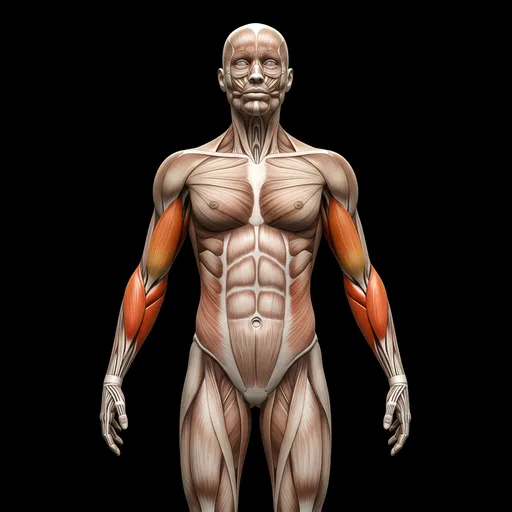
Which muscles does it train?
ForearmsBiceps
Equipment needed
How to perform it
Isolation work is usually trained in a higher rep range: 2 to 4 sets of 10 to 15 reps with 45 to 90 seconds of rest, performed under control.
Execution and technique cues
- Stand upright with feet shoulder-width apart and grip the barbell with an overhand grip at shoulder width.
- Keep your elbows tucked close to your ribs and pin your shoulders back and down.
- Curl the barbell upward by flexing at the elbows while keeping your wrists straight and locked.
- Lower the barbell slowly to the starting position until your arms are fully extended.
Common mistakes
- Letting the elbows drift forward, which shifts the tension away from the forearms and biceps.
- Allowing the wrists to bend backward under the weight of the barbell.
- Swinging the torso to generate momentum for lifting the barbell.
Frequently asked questions
- Why is the reverse curl harder than a regular bicep curl?
- The pronated grip places the biceps in a mechanically disadvantaged position, forcing the brachioradialis and pronator teres of the forearm to do more work.
- What barbell is best for reverse curls?
- An EZ-bar is often preferred as its angled grips reduce stress on the wrists compared to a straight barbell.
Related exercises
Start free and track it
Log this exercise in Ironstead. Free forever for athletes, no auto-renew.
Start free and track itConnect with a coach
Train with a coach? Link up in Ironstead so they write your plans and follow your progress.
Connect with a coachWrite plans as a coach
Build plans with this exercise and assign them to your athletes. 30-day trial.
Write plans as a coach