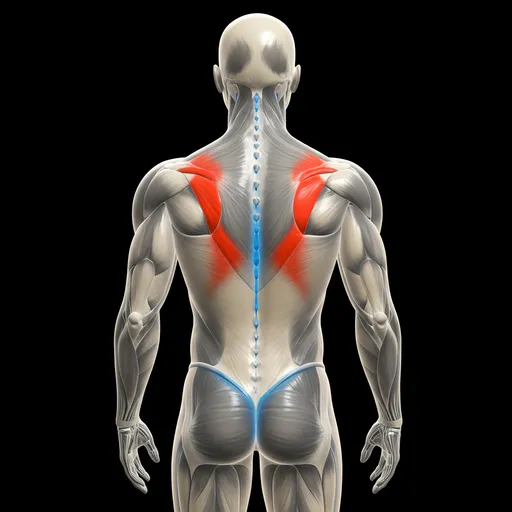
Which muscles does it train?
BackBicepsForearmsLats
Equipment needed
How to perform it
For strength, use 3 to 5 heavy carries over 10 to 20 meters with 2 to 3 minutes of rest. For conditioning and volume, use 3 to 4 carries over 30 to 50 meters at a moderate load.
Execution and technique cues
- Sit on the ground or stand in a hinged position behind the sled, grip the rope with both hands, and lean back slightly to create tension in the rope before pulling begins.
- Pull the rope hand over hand in an alternating pattern, driving each pull from the back and biceps and allowing the shoulder blade to fully retract with each rep.
- Keep the torso braced and stable throughout, resisting the urge to rock the upper body back and forth with each hand pull.
- Maintain a continuous, rhythmic pulling pace so the rope never goes slack and the sled moves smoothly without sudden jerks or stops.
Common mistakes
- Rocking the torso aggressively with each pull, which generates momentum and shifts the workload away from the back and arms.
- Pulling the rope off to one side instead of straight back, which reduces pulling efficiency and places asymmetric stress on the shoulder joint.
- Using too little weight, so the sled moves too easily and does not generate meaningful tension in the lats, traps, and biceps during the pull.
Frequently asked questions
- What is the primary benefit of the arm-over-arm sled pull compared to seated cable rows?
- The sled pull provides continuous accommodating resistance with no deceleration phase, which keeps muscles under tension throughout. It also trains grip endurance and the ability to sustain pulling force over time or distance, making it effective for general physical preparedness and sport-specific conditioning. There is no eccentric phase, which reduces muscle soreness and allows for higher training frequency.
- Can the arm-over-arm sled pull be performed standing instead of seated?
- Yes. Standing while leaning back in a hinged position is a common and effective variation. It increases the demand on the posterior chain and requires greater hip stability. Seated variations on the floor tend to isolate the upper back and arms more directly. Both positions are valid and can be selected based on the training emphasis.
Related exercises
Start free and track it
Log this exercise in Ironstead. Free forever for athletes, no auto-renew.
Start free and track itConnect with a coach
Train with a coach? Link up in Ironstead so they write your plans and follow your progress.
Connect with a coachWrite plans as a coach
Build plans with this exercise and assign them to your athletes. 30-day trial.
Write plans as a coach