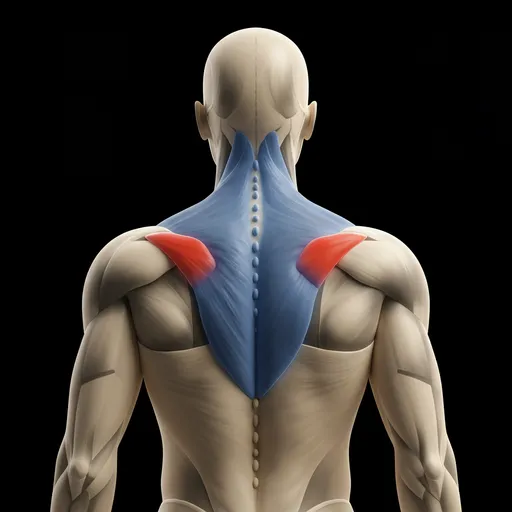
Which muscles does it train?
Traps
Equipment needed
How to perform it
For strength, use 3 to 5 heavy carries over 10 to 20 meters with 2 to 3 minutes of rest. For conditioning and volume, use 3 to 4 carries over 30 to 50 meters at a moderate load.
Execution and technique cues
- Set the cable pulley to the lowest position and grip the straight bar or two single handles with a shoulder-width, overhand grip. Stand upright with arms fully extended and the cable running in a straight line from the pulley to your hands.
- Shrug the shoulders straight up toward the ears as high as possible, keeping the head neutral, eyes forward, and the core braced throughout.
- Pause briefly at the top and consciously squeeze the upper traps before beginning the descent.
- Lower the shoulders fully in a controlled manner until a mild stretch is felt in the traps, then initiate the next rep from that lengthened position without any torso swinging.
Common mistakes
- Rolling the shoulders forward or backward in a circular motion, which adds no additional trap activation and unnecessarily stresses the shoulder joint.
- Jutting the head forward or tucking the chin during the shrug, placing unnecessary strain on the cervical spine. The head should stay in a neutral position throughout.
- Loading the cable too heavy and using torso momentum to initiate the shrug rather than pure trapezius contraction.
Frequently asked questions
- How does the cable shrug differ from a dumbbell or barbell shrug?
- The cable pulley applies tension from below, which keeps the load on the traps even at the bottom of the movement where free weights have relatively low tension. This makes the cable shrug effective for loading the full range of motion and is a useful complement to free-weight variations.
- Should the elbows be bent during the cable shrug?
- No. The arms should remain straight throughout the movement. Bending the elbows shifts the work to the biceps and reduces the direct stimulus on the trapezius. Think of the arms as hooks and initiate all movement from the shoulder girdle.
Related exercises
Start free and track it
Log this exercise in Ironstead. Free forever for athletes, no auto-renew.
Start free and track itConnect with a coach
Train with a coach? Link up in Ironstead so they write your plans and follow your progress.
Connect with a coachWrite plans as a coach
Build plans with this exercise and assign them to your athletes. 30-day trial.
Write plans as a coach