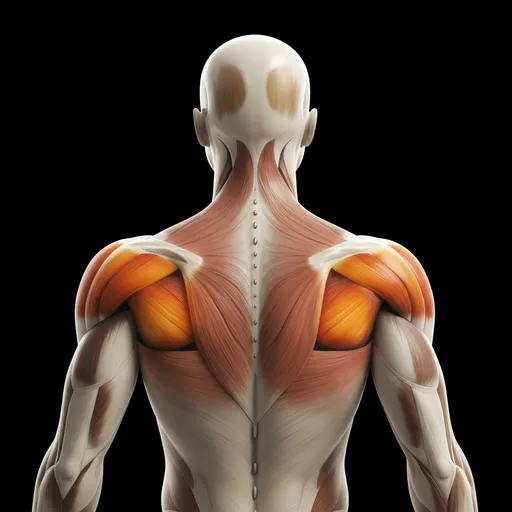
Which muscles does it train?
ShouldersBackTraps
Equipment needed
How to perform it
For strength, 3 to 5 sets of 4 to 6 reps with 2 to 3 minutes of rest are common. For hypertrophy, use 3 to 4 sets of 8 to 12 reps with 60 to 90 seconds of rest.
Execution and technique cues
- Set both cable pulleys to shoulder height, then cross your arms and grab the left cable with your right hand and the right cable with your left hand, so the cables cross in front of your chest.
- Step back slightly so there is tension on the cables with your arms reaching forward, keep a soft bend in the elbows throughout to protect the joints.
- Drive both arms apart in a wide arc to the sides and slightly behind you until your hands reach shoulder level, leading with the rear delts and upper back rather than pulling with the arms.
- Hold the peak contraction for one second while squeezing the rear delts, then return the handles slowly and under control to the starting position without letting the weight stack touch down.
Common mistakes
- Using too much weight and swinging the torso back and forth to generate momentum, which shifts the load away from the rear delts and onto the lower back.
- Bending the elbows too much during the movement, effectively turning the exercise into a row and reducing the stimulus on the posterior deltoid.
- Allowing the shoulder blades to remain flat rather than actively retracting them at the top, which lets the trapezius dominate instead of the rear delts.
Frequently asked questions
- Should the cables be crossed or kept separate for the reverse fly?
- The crossed-cable setup (right hand grips left cable, left hand grips right cable) is the most common approach and creates continuous tension through a full range of motion. Using two separate handles without crossing is also valid and changes the pull angle slightly. Both variations effectively target the rear deltoid.
- What is a good rep range for the cable reverse fly?
- The rear deltoid responds well to moderate to higher rep ranges. Sets of 12 to 20 reps with a controlled tempo, emphasising the squeeze at the top, are generally more effective than low-rep heavy loading for this isolation movement.
Related exercises
Start free and track it
Log this exercise in Ironstead. Free forever for athletes, no auto-renew.
Start free and track itConnect with a coach
Train with a coach? Link up in Ironstead so they write your plans and follow your progress.
Connect with a coachWrite plans as a coach
Build plans with this exercise and assign them to your athletes. 30-day trial.
Write plans as a coach