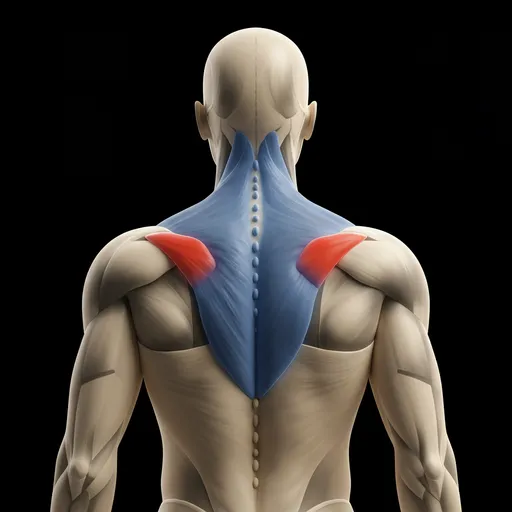
Which muscles does it train?
Traps
Equipment needed
How to perform it
For strength, use 3 to 5 heavy carries over 10 to 20 meters with 2 to 3 minutes of rest. For conditioning and volume, use 3 to 4 carries over 30 to 50 meters at a moderate load.
Execution and technique cues
- Stand upright holding a dumbbell at each side with arms straight, feet hip-width apart, and eyes looking straight ahead.
- Shrug the shoulders straight up toward the ears without bending the elbows or tilting the torso.
- Hold the top position briefly to achieve a peak contraction in the trapezius.
- Lower the shoulders slowly back to the start to use the full range of motion on every rep.
Common mistakes
- Rolling the shoulders in a circular motion, which does not increase trapezius activation and adds unnecessary stress to the shoulder joints.
- Pushing the head and neck forward as the shoulders rise, which creates poor alignment in the cervical spine.
- Using too much weight and only achieving a minimal shrug, sacrificing range of motion for load.
Frequently asked questions
- Should I roll my shoulders during a dumbbell shrug?
- No. A straight vertical shrug is more effective and safer for the shoulder joints. Rolling the shoulders does not meaningfully increase trapezius activation and can irritate the AC joint over time.
- Should I hold the dumbbells with palms facing inward or facing forward?
- Both grips work. A neutral palms-in grip is the most natural position for most people and tends to be more comfortable. Grip orientation has no significant impact on trapezius activation.
Related exercises
Start free and track it
Log this exercise in Ironstead. Free forever for athletes, no auto-renew.
Start free and track itConnect with a coach
Train with a coach? Link up in Ironstead so they write your plans and follow your progress.
Connect with a coachWrite plans as a coach
Build plans with this exercise and assign them to your athletes. 30-day trial.
Write plans as a coach